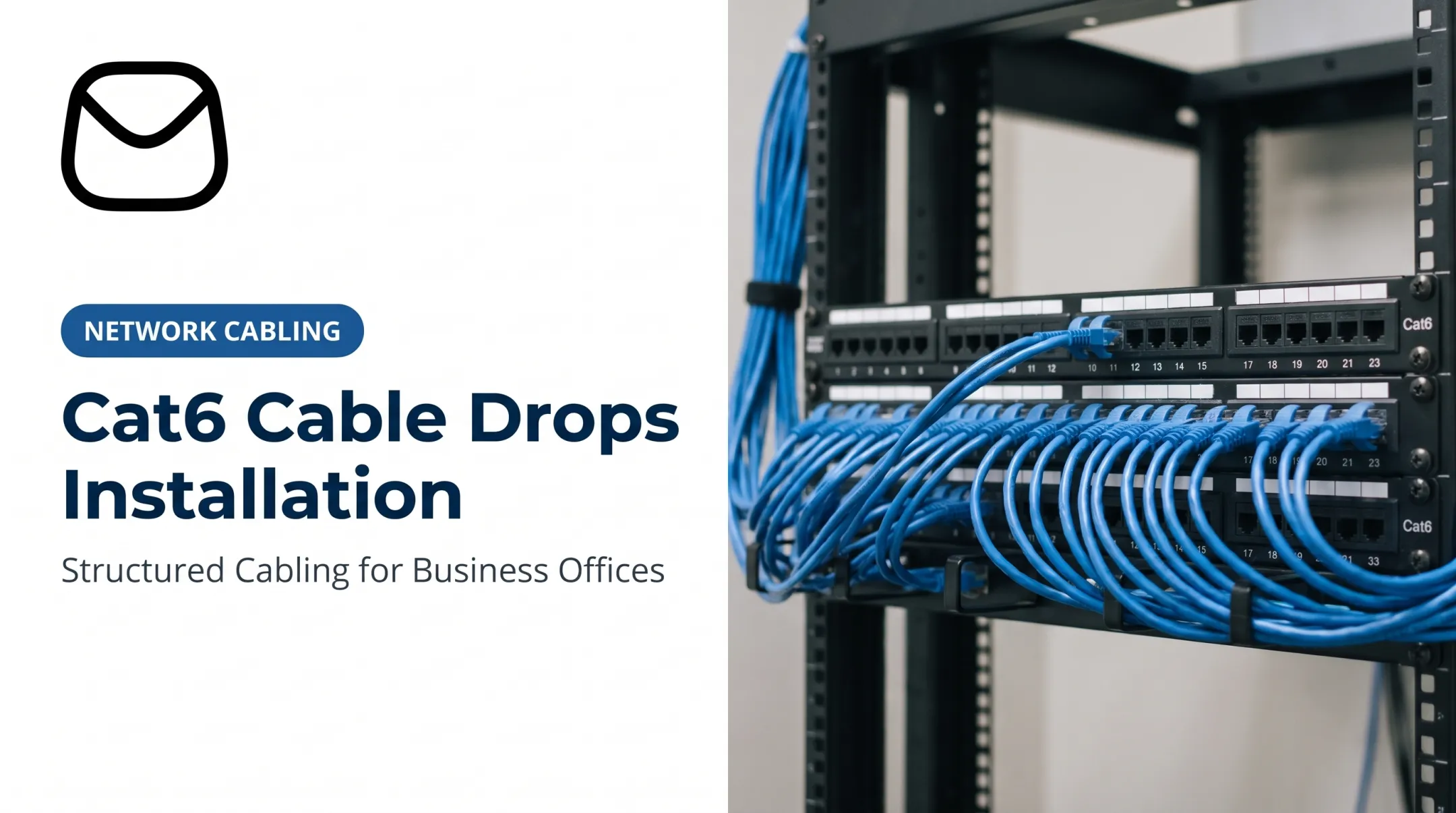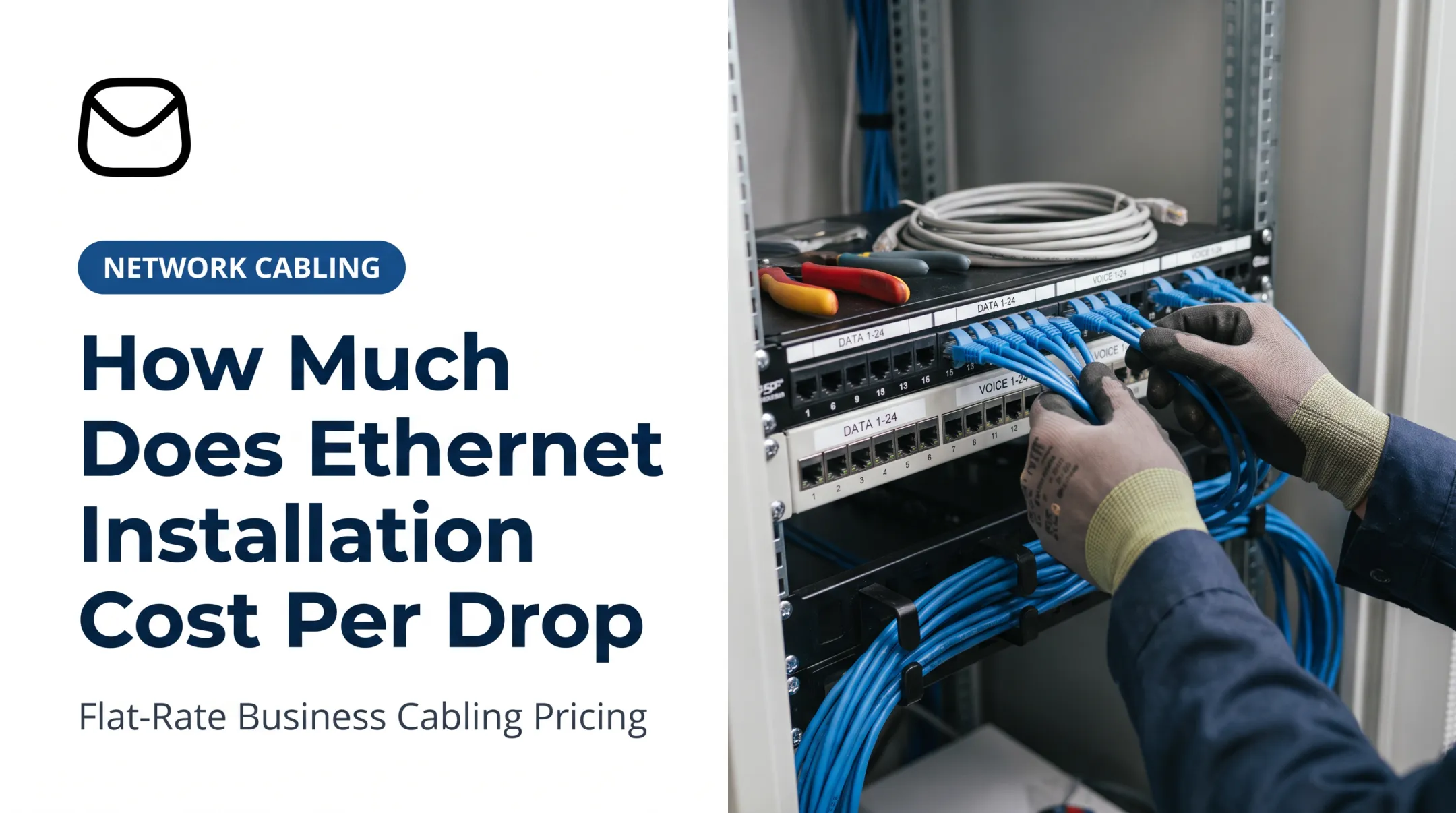

Many businesses only notice cabling when it fails: a dead jack, static on a line, or a VoIP rollout that stalls because the building can't support it. This guide is for companies planning a new office, relocation, expansion, VoIP deployment, or cabling repair. It covers cable types, how professional installation works, and how to evaluate an installer.
Key Takeaways
- Legacy phone lines use copper twisted-pair; most modern systems use Ethernet-based structured cabling for VoIP.
- A real installation starts with a site survey, not a cable pull.
- Testing, labeling, and documentation are part of the job, not extras.
- Pick a provider that plans for growth and stays around for troubleshooting.
What Is Telephone Cabling?
Definition and scope
Telephone cabling is the physical infrastructure that connects phones, jacks, cross-connects, phone systems, and communication networks inside a building. In a modern office, voice often travels over the same structured Ethernet cabling and network switches as data.
BICSI's 007-2020 standard treats this as part of an integrated premises infrastructure rather than a standalone phone wire. That matches how most offices are built today.
One boundary matters: your cabling stops where the carrier's begins. Under 47 CFR 68.3, the demarcation point separates the provider's facilities from customer-premises wiring. Everything on your side is yours to plan and maintain.
Common cable, connector, and termination components
Typical components include:
- Copper twisted-pair cable
- Telephone jacks and wall plates
- Patch panels and cross-connect blocks
- Patch cords and equipment racks
Traditional telephone jacks use RJ11 (6P2C) or RJ12 (6P6C) modular connectors. RJ45 (8P8C) connectors are the common format for Ethernet and IP phones. But a connector's shape doesn't prove compatibility. The category rating of the cable and what the equipment requires matter more.
Business uses for telephone and telecommunications cabling
- Traditional analog or digital phone lines
- On-premises business phone systems
- Fax and specialty equipment, where still used
- VoIP phones on a structured cabling network
Planned cabling makes phone moves, troubleshooting, and expansion straightforward. An undocumented tangle of extensions and improvised connections does the opposite.
What Services Does a Telephone Cabling Installation Company Provide?
New-office, relocation, and expansion installations
Before employees arrive, an installer plans phone locations, cable drops, equipment-room connections, pathways, wall plates, racks, and patching. That planning supports businesses adding workstations, opening extra sites, renovating, or adding endpoints for hybrid teams.
QTSI works with SMBs, franchises, and clinics fitting out new or expanded space. The physical network, cabling, and phone system are installed and integrated before opening day.
Repairs, testing, and troubleshooting
Technicians trace the physical-layer problems behind most "the phone is broken" calls:
- Dead jacks and intermittent connections
- Static, noise, and crossed lines
- Damaged cable and failed terminations
Effective troubleshooting isolates the fault first, then recommends repair or full cable replacement.
Integration with phone and IT systems
Cabling has to work with the VoIP platform, switches, internet connectivity, and unified communications. A cabling job that ignores the network design can leave phones without power or bandwidth. QTSI offers cloud-based VoIP (call routing, auto-attendant, mobile integration), structured cabling, and managed IT together so these pieces can be planned as one environment.
How Professional Telephone Cabling Installation Works
Site survey and requirements assessment
Technicians walk the site and document what will shape the design:
- Building layout, construction materials, and access limits
- Existing cabling, demarcation point, and equipment rooms
- Phone locations, business hours, and expected growth
Questions a good installer asks:
- What phone system do you run now, and are you moving to VoIP?
- How many users, and any special devices?
- Are there multiple offices?
- How much downtime is acceptable?
Cabling design and material selection
From that survey, the installer maps routes, chooses compatible cable and termination hardware, plans pathways and equipment-room connections, and decides what existing infrastructure can be reused.
Cable jacket ratings matter. CM/CMG is general-purpose, CMR is for riser runs, and CMP is for plenums and other air-handling spaces, per Siemon's jacket guide. The NEC is adopted state by state, so confirm requirements with your authority having jurisdiction (AHJ).
Installation, routing, and termination
Professionals handle the physical work that commercial spaces demand:
- Cable pulling, support, and bend-radius protection
- Separation from electrical interference
- Firestopping through rated walls and neat terminations
This is not a DIY job in a commercial building, especially where ceilings and fire-rated walls are involved.
A home-run, star-style layout, with each endpoint cabled back to the equipment room, makes troubleshooting and later changes far easier.

Testing and performance verification
Not all tests are equal:
- Wire-map or continuity tests catch opens, shorts, reversed pairs, and split pairs. They don't prove a link meets performance limits.
- Certification testing measures parameters like length, attenuation, and crosstalk against standard limits, as Fluke Networks describes.
Balanced twisted-pair permanent links top out at 90 m, and the full channel, including cords, at 100 m. Any certification claim should be backed by the applicable standard and test equipment.

Labeling, documentation, activation, and handoff
A complete handoff includes:
- Endpoint labels and cable schedules
- Route documentation and patch-panel records
- Test results, plus photos where useful
- Updated building or network diagrams
The installer then coordinates final activation with the phone provider or your IT team and confirms phones work from every location.
How to Choose the Right Cable and Installation Approach
Match the cable to the phone system
The right choice depends on whether you run analog, digital, hosted VoIP, an on-premises PBX, or a hybrid, Match that system to the equipment's connector, pair, bandwidth, and power needs.
| Cable | Typical fit |
|---|---|
| Cat 5e | Voice and data; supports PoE and 1000BASE-T |
| Cat 6 | 1 Gb/s to 100 m; 10GBASE-T to roughly 55 m |
| Cat 6A | 500 MHz; 10GBASE-T to 100 m |
IP phones typically use four-pair Ethernet cable and often draw power over Ethernet (PoE) from the switch. Standard 802.3af delivers 15.4 W at the switch and 12.95 W at the device. Legacy copper or specialized wiring can still be right for older analog or PBX equipment. Check the phone's spec sheet.
Account for building conditions and installation pathways
Consider:
- Indoor versus outdoor routes and moisture exposure
- Plenum or riser spaces
- Pathway capacity and cable protection
- Electrical interference, grounding, and bonding
- Firestopping at rated walls and floors
Follow current codes, manufacturer instructions, property-management rules, and local requirements rather than a generic cable guide.
Plan for growth and maintainability
Plan these items before walls and ceilings close:
- Spare capacity and extra drops
- Accessible patch panels and organized racks
- Clear labels and documented routes
Adding a drop later costs far more than adding it during construction. Scalable design keeps moves, adds, and changes less disruptive.
Why Work With a Professional Telephone Cabling Installation Company?
Reduce installation risks and business disruption
Commercial cabling touches ceilings, walls, equipment rooms, and workstations. Professional planning reduces rework, unsafe routing, accidental damage, and downtime. Technicians can also schedule around your hours and coordinate with facilities, construction teams, carriers, phone vendors, and internal IT.
Gain reliable testing and troubleshooting support
A good installer delivers more than cable placement. Ask about:
- Testing methods and results provided
- Project documentation
- Warranty terms
- Service response and maintenance options
- How future moves and additions are handled
Cable problems cause outages. The Uptime Institute's 2026 analysis found fiber and cable incidents were the leading cause of publicly reported IT service outages in 2025, though it doesn't isolate in-building office cabling.
Connect cabling with broader communications and IT requirements
An installer with networking expertise can spot dependencies involving VoIP, switches, internet service, unified communications, and business continuity. Cabling alone doesn't solve every IT or security issue, but it is the foundation the rest depends on.
Get started with QTSI
A provider that handles both the cable plant and the systems it feeds can keep those pieces aligned. QTSI (Quickconnect Technology Services, Inc.) was founded in 2001 and is based in Wayne, New Jersey. It provides structured cabling, communications, networking, VoIP, and managed IT for small to mid-sized businesses and nonprofits.
If you're in New Jersey, New York, Pennsylvania, or the wider Tri-State area, QTSI offers a free, no-obligation IT assessment covering telephone cabling, office moves, communications upgrades, or broader infrastructure. Call 866-640-5038.
Frequently Asked Questions
What is telecommunications cabling?
It's the physical infrastructure that carries voice, data, and related communications. Traditional telephone wiring is one part of that broader category.
What is the difference between telephone cabling and Ethernet cabling?
Telephone cabling typically uses RJ11/RJ12 connectors and fewer conductor pairs. Ethernet uses four-pair, Category-rated cable with RJ45 connectors and tighter signal requirements. Ethernet-based structured cabling commonly supports modern VoIP phones.
What type of cabling is used for VoIP phones?
VoIP phones usually connect over four-pair Ethernet cabling such as Cat 5e or Cat 6 to a network switch. The phone system, network design, and standards set the final cable and power requirements.
Can telephone cabling be installed in an existing office?
Often, yes. An installer first reviews routes, ceilings, walls, equipment rooms, access, building rules, and business-hour constraints.
How much does telephone cabling installation cost?
Cost depends on drop count and type, cable distance, building access, pathways, terminations, testing, old-cable removal, and integration. A site-specific assessment is more reliable than any generic price.
Can telephone and electrical cables share the same pathway?
Not carelessly. Interference and code concerns apply, so separation, crossing, grounding, and firestopping rules must be followed. A qualified installer handles this and confirms requirements with your AHJ.