
Introduction
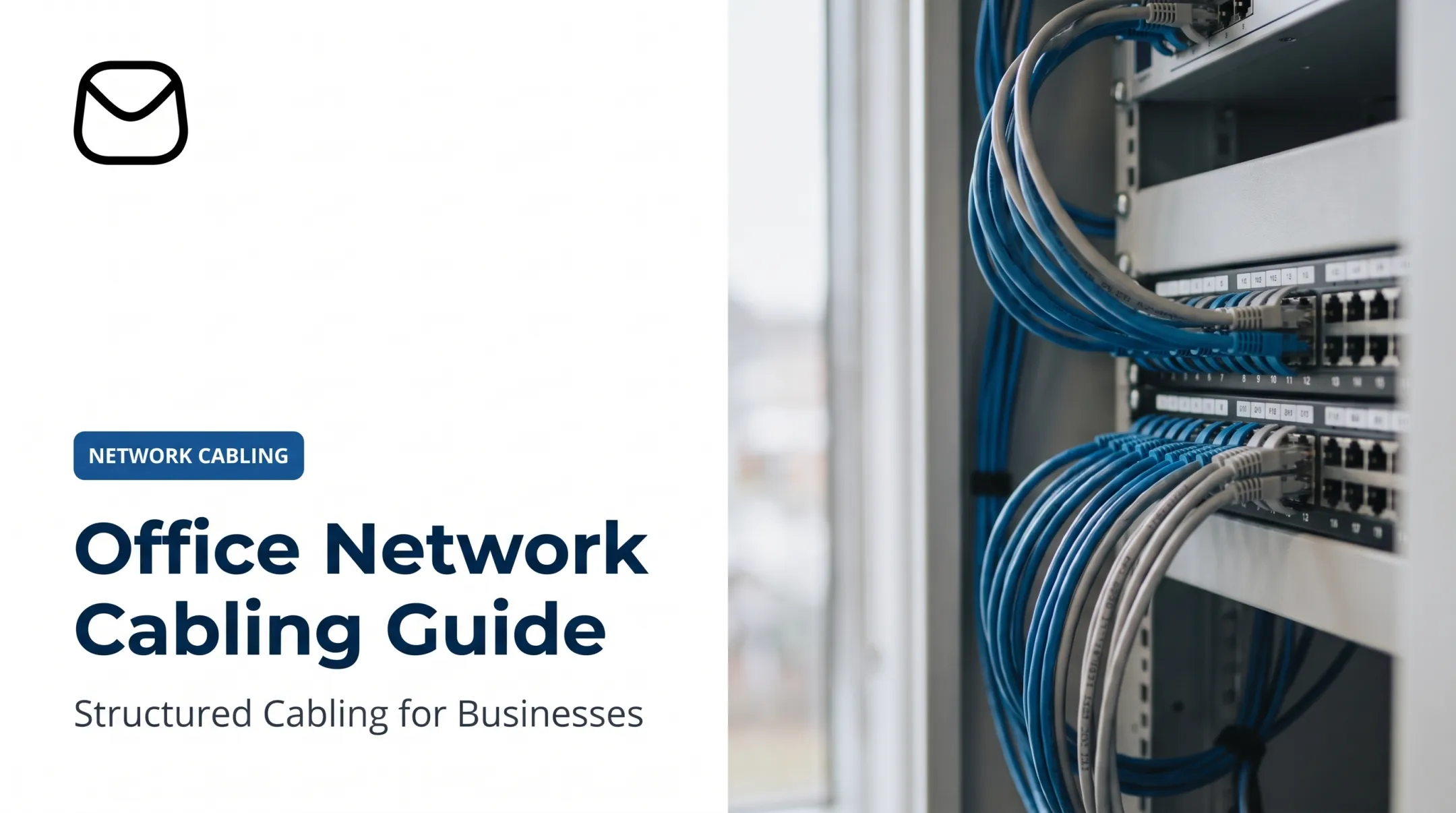
Structured cabling is the physical foundation under business data, voice, wireless, security cameras, and access control. When it's wrong, everything on top of it suffers.
There is no universal price. Cost swings with drop count, run length, Cat6, Cat6A, or fiber specs, building access, labor, pathways, testing, and the network room itself. In 2026, most contractors quote by the drop.
This guide gives sourced U.S. planning ranges, breaks down the cost components, walks through a calculator model, and lists what you need to get a reliable quote.
Key Takeaways
- Installed cost per drop beats cable price alone as a budgeting number.
- 2026 contractor ranges: about $150-$300 per copper drop, $300-$650 per fiber.
- Access, retrofit work, after-hours labor, and small job size push prices up.
- The cheapest quote can cost more once testing, patch panels, and firestopping are added.
- Budget for growth, not just today's headcount.
How Much Does Structured Cabling Cost? (Pricing Overview)
Treat every figure below as a planning range, not a quote. Most are contractor-published estimates rather than independent surveys, and their included scope varies.
Misreading price causes three common problems:
- Underbudgeting leads to reduced scope, change orders, or postponed pathway and network-room work.
- Quotes with different inclusions look comparable until testing, patch panels, or documentation get added.
- Picking a cable category without considering bandwidth, PoE, distance, and service life creates upgrade costs later.
Installed cost per drop and cable-only cost per foot are different things. A 1,000-ft box of plenum Cat6 lists around $0.375 per foot, but that is material only, with no labor, termination, or testing.
Basic / Entry-Level Structured Cabling
This band fits a small number of straightforward copper drops, accessible ceilings, standard daytime labor, and limited telecom-room work.
SRS Networks lists $150-$225 per Cat6 drop as a 2026 U.S. average, though it doesn't define the per-drop scope.
A regional guide from Atkins Tech Solutions gives $150-$250 for Cat6 in Eastern Pennsylvania and Northern New Jersey. That figure typically includes cable, jack, patch-panel port, TIA-606 label, and certification test.
Common exclusions:
- Network switches and other electronics
- Extensive pathway construction
- Fiber backbones
- Permits
- Remediation of existing cabling
Standard Commercial Structured Cabling
Think of an office, clinic, or nonprofit fit-out with many endpoint types, a defined telecom room, labeling, testing, and Cat6 or Cat6A.
| Cable | National estimate (SRS) | Regional estimate (Atkins, accessible ceilings) |
|---|---|---|
| Cat6 | $150-$225 per drop | $150-$250 per drop |
| Cat6A | $200-$300 per drop | $200-$350 per drop |

Atkins separates pathways, firestopping, and racks from these figures. Larger, well-planned jobs may price lower per drop, but none of the sources publishes a volume-discount schedule, so ask for tiered pricing.
Advanced, Fiber, or Complex Structured Cabling
Fiber backbones, building-to-building links, long or difficult runs, high-density PoE, hard ceilings, conduit, occupied spaces, after-hours work, and multiple telecom rooms all land here.
SRS lists $300-$650 per fiber drop, varying by single-mode versus multimode and termination count. It doesn't separate interior from exterior work. Atkins says finished walls, plenum cable, after-hours work, and low drop counts push regional copper work toward $250-$400+ per drop.
For exterior or complex fiber, a well-defined 2025-2026 U.S. installed range is hard to find. Don't plug in a default number. Budget separate allowances for:
- Fiber and terminations or splicing
- Trenching, aerial, or conduit pathways
- Testing
- Design
- Site-specific labor
Key Factors That Affect the Cost of Structured Cabling
Price is the combined result of technical requirements, building conditions, labor effort, project scale, and the assurance level you need.
Cable Type and Performance Requirements
Cat6A supports 10G up to 100 m, Panduit states, including under PoE. Existing Cat6 may carry 10GBASE-T only over limited lengths; Fluke reports 35 m for the systems it discusses, and recertification is needed to confirm any link.
Other points to weigh:
- PoE guidance (TSB-184-A) covers 15.4 to 90 W and assumes a 100 m channel. Bundle size limits vary by category and power level.
- In Leviton's test of 37-cable bundles, shielded bundles ran 2 C cooler than UTP. That's one manufacturer result, not a rule.
- Multimode reach depends on the application. For 10GBASE-SR, OM3 reaches 300 m and OM4/OM5 reach 400 m.
- Corning reports no distance benefit for OM5 over OM4 at 850 nm. Single-mode costs more in optics but removes most distance worries.

Confirm all claims against current standards and manufacturer documentation.
Number of Drops, Endpoint Mix, and Project Scale
Every desk, phone, printer, access point, camera, conference room, and door controller needs a drop. The mix drives material, labor, and telecom-room capacity.
TIA-568.1-E Addendum 1 calls for two Cat6A cables per wireless access point. Count that in.
Very small jobs carry a higher per-drop cost because mobilization, design, and travel are spread across fewer connections. Big jobs dilute those fixed costs.
Run Length, Pathways, and Building Access
Longer runs, vertical routing, and service loops add cable and labor. Existing tray, J-hooks, conduit, and risers help. Congested pathways and fire-rated penetrations don't.
Compare an open ceiling grid with hard-lid ceilings, concrete walls, finished spaces, or restricted building access. The second group costs materially more.
New Construction vs. Retrofit Installation
New construction or pre-finish installation gives crews open access. Retrofits may need drilling, ceiling or wall access, furniture protection, patching, and coordination with occupants.
Schedule, Labor, and Site Coordination
Normal daytime work is cheapest. These conditions raise labor cost:
- Nights and weekends
- Phased moves and repeat mobilizations
- Security escorts and limited loading access
- Union requirements and compressed schedules
Atkins flags after-hours work as a cost-up factor. Ask your bidder for a specific after-hours premium instead of assuming a standard uplift.
Testing, Documentation, and Standards Requirements
A wire-map test checks continuity and pin mapping. Fluke notes it can still pass a split pair and doesn't verify bandwidth. Certification measures across frequencies against a standard.
Ask which of these your bid covers:
- TIA-568 series (568.2-E for copper, released November 2024; 568.3-E for fiber)
- TIA-569 for pathways and spaces
- TIA-606 for labeling and records
- TIA-607-E for bonding and grounding
- BICSI TDMM and ITSIMM guidance
- Per-run test reports and as-built drawings
- Manufacturer warranty registration (Panduit offers 15-25 year programs; terms are program-specific)
Cost Breakdown of Structured Cabling
A reliable budget separates one-time installation, recurring costs, and periodic upgrades. Cable is only part of it.
| Category | Timing | What it includes |
|---|---|---|
| Initial materials and design | One-time | Cable, jacks, faceplates, patch panels, racks, cable management, fiber enclosures, design. Passive cabling only; switches are separate. |
| Installation, termination, setup | One-time | Pulling, routing, supporting, terminating, labeling, firestopping, rack organization, pathways, trade coordination. |
| Testing, certification, closeout | One-time, possible retesting | Test method, per-run reports, label verification, as-builts, warranty process. |
| Operations and maintenance | As needed | Moves, adds, changes, troubleshooting, damaged connections, documentation updates. |
| Upgrades and expansion | Periodic | Extra drops, telecom-room capacity, fiber, pathways, remediation, higher bandwidth or PoE needs. |

University specifications give a sense of real scope. The 2026 Pitt Division 27 spec requires firestopping tray penetrations with UL-listed systems, record drawings, fiber testing, and replacement and retest of failed cable. Houston's 2025 spec includes runway and basket tray.
Per-MAC pricing and service life vary by project; no single standard applies. Don't treat warranty length as lifespan.
Low-Cost vs High-Cost Structured Cabling—and How to Estimate the Right Budget
Low-Cost vs High-Cost Structured Cabling: What's the Difference?
Look past the headline number at what's actually specified.
- Lower-cost: Fits a simple, accessible project when category, testing, documentation, and expansion needs are clearly defined.
- Higher-cost: Justified by heavy bandwidth or PoE needs, difficult access, fiber backbones, certified testing, strong documentation, warranty eligibility, or growth plans.
- Performance: Compare category, workmanship, termination quality, test method, and whether it supports your network gear.
- Maintainability: Look at cable support, bend-radius control, labeling, rack organization, and how easy future changes will be.
A properly scoped premium installation can cut troubleshooting, rework, and downtime. But don't pay for specs you don't need.
How to Use a Structured Cabling Cost Calculator
Gather these inputs first:
- Project type: new build, relocation, retrofit, occupied space, ceiling type, work-hour limits.
- Endpoints by type: workstations, phones, access points, cameras, printers, conference rooms, access control.
- Cable specs: Cat6, Cat6A, shielding, fiber type, backbone, PoE, bandwidth.
- Run assumptions: approximate lengths, telecom-room locations, vertical routing, runs near design limits.
- Supporting infrastructure: racks, patch panels, trays, conduit, firestopping, labeling, testing, documentation.
Then use this model:
Total budget = (endpoint drops × installed rate) + fiber/backbone work + pathway and telecom-room costs + design/permit allowances + testing and closeout + contingency

Example: 60 Cat6A drops at $250 each total $15,000. Add separately priced fiber, rack buildout, and firestopping, then a contingency.
AIA describes contingency as a predetermined amount for unpredictable changes, but sets no universal percentage for cabling. Pick a rate with your contractor based on site risk.
A good calculator lets you change assumptions and watch the total move. The output is a planning estimate, not a substitute for a site survey.
What Most People Miss on Structured Cabling Cost
Per-drop numbers hide a lot. Frequently omitted or separately priced items:
- Patch cords and patch panels
- Cable support and conduit
- Firestopping
- Rack buildout
- Backbone fiber
- Removal of abandoned cable (New York City code, for one, requires removing accessible abandoned cable)
- Permits and after-hours labor
- Testing and closeout documentation
Over-specifying premium cable without a technical need wastes money. Choosing the cheapest bid without checking testing, labeling, warranty eligibility, pathway compliance, and workmanship costs more later.
Require every contractor to state:
- Cable category and drop count
- Endpoint assumptions
- Included accessories
- Labor conditions
- Testing level
- Documentation
- Exclusions
- Warranty terms
- Change-order rules
If you're opening or relocating an office, QTSI can assess structured cabling and related network needs. The goal is a scalable, integrated infrastructure plan and a more predictable technology budget.
Conclusion
Structured cabling cost varies with cable category, drop quantity, run length, building access, pathways, labor, testing, and supporting infrastructure. A calculator only helps if it starts with a complete endpoint and scope inventory, uses current U.S. pricing, and separates inclusions from exclusions.
The right investment balances performance, standards compliance, reliability, maintainability, and room to grow, not simply the lowest bid.
Frequently Asked Questions
How much does structured cabling cost?
Contractor-published 2026 U.S. ranges are about $150-$300 per copper drop and $300-$650 per fiber drop. That's a starting point; access, pathways, testing, labor, and project size move the total.
How do you calculate structured cabling costs?
Count endpoint drops, choose cable categories, estimate run lengths, and apply installed rates. Then add pathways, telecom-room infrastructure, testing, documentation, and a contingency.
How much does Cat6 cabling cost per foot?
Bulk plenum Cat6 lists around $0.375 per foot as material only. A complete commercial drop costs far more once labor, termination, and testing are included.
How much should I pay to run an Ethernet cable through a house?
Angi reports a 2026 residential average of $1,500, with $50-$100 per port plus $60-$120 per hour labor. Don't apply commercial per-drop ranges to a single home run.
What does structured cabling mean?
It's a planned cabling infrastructure with standardized pathways, terminations, labeling, testing, and telecom spaces. It supports data, voice, wireless, security, and other connected systems.
What is the standard for structured cabling?
The ANSI/TIA-568 series is the foundation, supported by TIA-569, 606, and 607 and BICSI guidance. Confirm building, fire-code, and manufacturer requirements with a qualified professional.