
Introduction
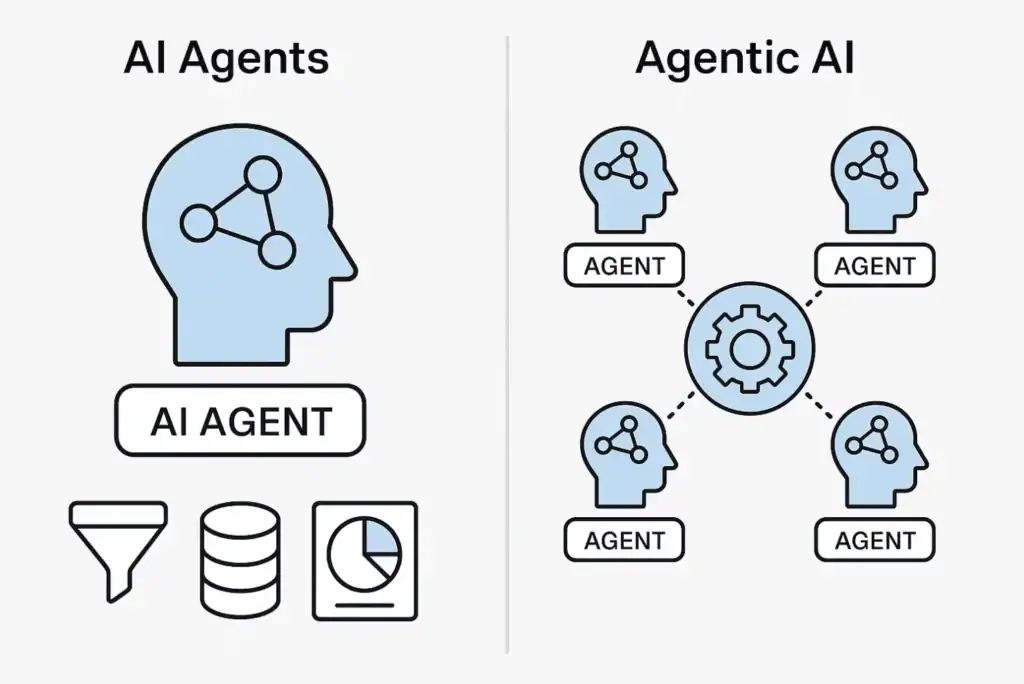
The rise of agentic AI, AI that can think, plan, and act on its own is transforming how enterprises operate. Unlike chatbots or rule-based automation, these AI agents autonomously handle complex tasks across multiple systems. To get the most out of agentic AI, organizations need an orchestration architecture, a framework that connects all these agents and allows them to work together seamlessly. Without it, AI projects can become fragmented and inefficient.
What is Orchestration Architecture?
Orchestration architecture is essentially the “conductor” for AI agents. Each agent specializes in a task from IT support to finance approvals and orchestration ensures they act in concert to complete multi-step workflows.
Think of it like a symphony: without a conductor, each instrument plays its own tune. With orchestration, agents collaborate, share context, and execute tasks efficiently across the enterprise (Moveworks, 2025).
Real-World Use Cases
1. IT & Service Desk
AI agents can handle entire support workflows end-to-end. One agent categorizes a ticket, another diagnoses the issue, and a third resolves it all without human intervention (Aisera, 2025). Companies using this approach report faster ticket cycles and fewer manual handoffs.
2. HR & Finance Workflows
Complex processes like employee onboarding or expense approvals benefit from orchestration. AI agents can collect employee data, set up payroll accounts, provision IT access, and validate tasks in sequence, reducing errors and saving time (Redwood, 2025).
3. Supply Chain & Operations
Orchestrated AI monitors inventory, predicts disruptions, and reroutes shipments automatically. By connecting logistics, procurement, and production, enterprises can respond in real time and reduce downtime (World Economic Forum, 2025).
4. Strategic & Cross-Enterprise Automation
Orchestration enables a “cognitive enterprise” where AI continuously senses, plans, and acts across departments. This breaks down silos and delivers unified, proactive operations in customer service, sales, and more (BCG, 2025).
Challenges and Risks
- Governance & Oversight: Autonomous agents need transparent controls, audit logs, and human supervision (Microsoft, 2025).
- Data & Infrastructure: High-quality, integrated data is essential for agents to function effectively (CIO, 2025).
- Ethics & Bias: AI must be designed responsibly, with compliance and fairness embedded in workflows (Microsoft, 2025).
- Skill & Culture: Teams must learn to design outcome-based workflows and embrace a culture of AI experimentation (BCG, 2025).
Preparing Your IT Team
- Start with Pilot Projects: Focus on high-impact areas like IT or finance workflows to show value quickly.
- Build Data & Integration Foundations: Create unified data pipelines and APIs for real-time information sharing.
- Adopt a Central Orchestration Platform: Use platforms like Moveworks to coordinate agent activities and monitor performance.
- Establish Governance: Define ownership, monitoring, and exception handling for AI workflows.
- Train & Empower Staff: Upskill teams, appoint AI champions, and encourage experimentation (Microsoft, 2025).
Conclusion
Orchestration architecture is key to unlocking the full potential of agentic AI. By connecting specialized agents into coordinated workflows, enterprises can move beyond fragmented automation toward adaptive, end-to-end intelligent systems. The future isn’t just about smarter tools — it’s about AI that acts on your goals, and orchestration is what makes it all work together.
References
Aisera. (2025). Agentic AI in enterprise workflows. https://aisera.com/blog/agentic-ai/
BCG. (2025). AI orchestration for enterprise efficiency. https://www.bcg.com/publications/2025/ai-orchestration
CIO. (2025). Preparing IT teams for agentic AI. https://www.cio.com/article/3989217/preparing-it-teams-agentic-ai.html
Microsoft. (2025). Responsible AI deployment and governance. https://www.microsoft.com/en-us/security/business/ai
Moveworks. (2025). Orchestration architecture for AI agents. https://www.moveworks.com/us/en/resources/blog/agentic-ai-the-next-evolution-of-enterprise-ai
Redwood. (2025). AI workflow automation in HR and finance. https://www.redwood.com/solutions/ai-automation
World Economic Forum. (2025). Cognitive enterprise and AI orchestration. https://www.weforum.org/stories/cognitive-enterprise-agentic-business-revolution/